
“The future of sustainability assurance depends on the development of skilled practitioners.”
At Integrated Reporting & Assurance Services (IRAS), we have a vested interest in the growth and development of the global sustainability assurance profession.
Part of that interest stems from the fact that our Managing Partner, Michael H Rea, is one of only 39 Lead Certified Sustainability Assurance Practitioners (LCSAPs) currently recognised worldwide.
However, our interest extends beyond professional recognition.
As an organisation committed to advancing the quality, credibility and accessibility of ESG reporting, sustainability reporting and sustainability assurance, we recognise that the future of the profession depends on the development of skilled assurance practitioners across multiple countries, industries and disciplines.
Understanding the Growth of the CSAP Designation
The Certified Sustainability Assurance Practitioner (CSAP) designation was developed by AccountAbility to help establish a globally recognised standard for professionals involved in stakeholder engagement, sustainability reporting, and sustainability assurance.
Today, CSAPs can be found in organisations across the world, supporting efforts to improve the quality, transparency and credibility of sustainability-related disclosures.
As interest in Environmental, Social and Governance (ESG) performance continues to grow, so too does the demand for practitioners capable of providing meaningful assurance over the sustainability content contained within annual reporting.
“Strong sustainability reporting requires strong sustainability assurance.”
To better understand how the profession is evolving, IRAS has undertaken independent research into the global growth of the CSAP designation.
Our research tracks where practitioners are located, how quickly the profession is expanding, and the role that professional training continues to play in developing future assurance providers.
The findings provide valuable insights for current practitioners, organisations seeking assurance services, and individuals considering a career in ESG assurance, sustainability reporting or stakeholder engagement.
IRAS’s Contribution to Global CSAP Growth
While the research itself remains the primary focus, IRAS is proud of the role it has played in supporting the growth of the profession.
As an approved AccountAbility CSAP Assurance Training Provider , IRAS has worked extensively to help professionals develop the technical knowledge required to become licensed practitioners.
Between August 2024 and March 2026 alone, Michael H Rea trained 181 new CSAPs representing 36 of the 55 countries where licensed CSAPs can currently be found.
This achievement builds upon Michael’s earlier contribution to CSAP training between 2009 and 2013 and reflects IRAS’s ongoing commitment to professional development within the sustainability assurance sector.
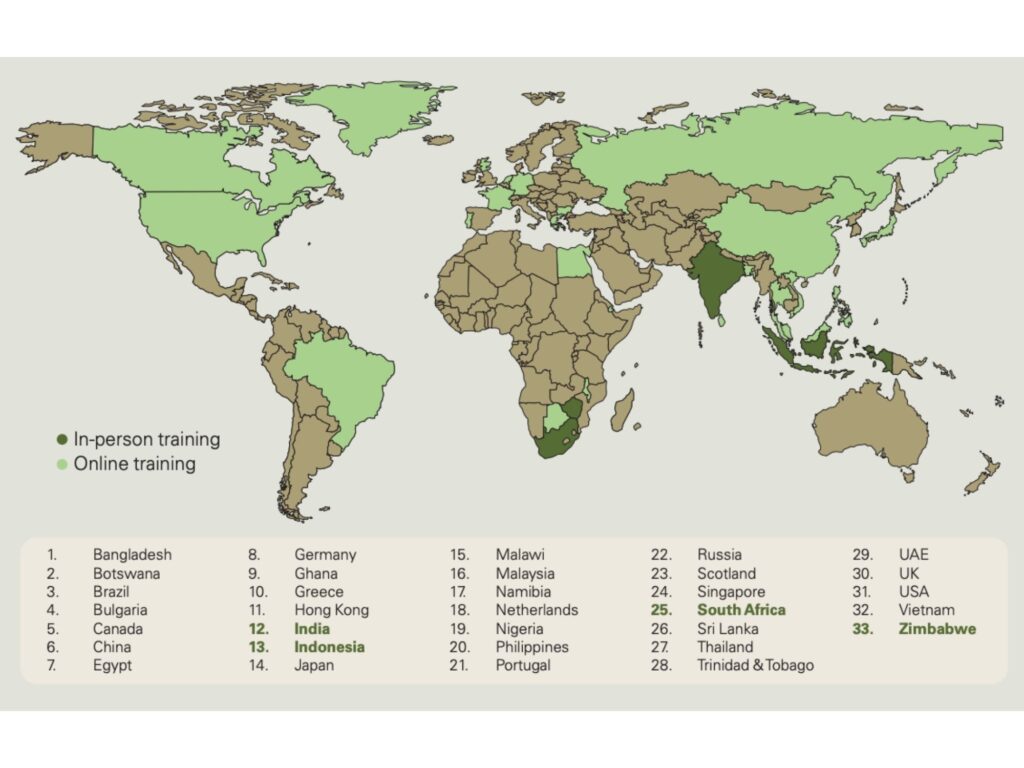
“The growth of the profession is not measured by certificates issued, but by the number of practitioners capable of improving the quality of sustainability reporting.”
Why CSAP training matters.
One of the distinguishing features of the CSAP programme is that it attracts participants from a diverse range of academic and professional backgrounds.
Participants include authors of ESG and sustainability reports, providers of sustainability assurance services, corporate sustainability professionals, impact investment managers, and members of sustainability-focused boards and committees.
This diversity is important because effective sustainability assurance requires both technical knowledge and practical understanding of how organisations manage, measure and communicate sustainability performance.
Through its training programmes, IRAS seeks to contribute to the development of practitioners who can help strengthen confidence in sustainability disclosures and improve the quality of decision-making by stakeholders.
“Good data drives good reporting. Bad data drives bad reporting.”
For those still unfamiliar with the realities of ESG reporting, sustainability reporting and sustainability assurance, the relationship between reporting quality and data quality is remarkably simple:
Good data drives good reporting.
Bad data drives bad reporting.
In providing value-adding ESG assurance and sustainability assurance services to our clients, Integrated Reporting & Assurance Services (IRAS) operates in a perpetual state of data collection, collation and analysis.
Each year, IRAS reviews the sustainability reporting of every company listed on the Johannesburg Stock Exchange (JSE), creating a database consisting of more than 60,000 sustainability-related data points annually by assessing performance against 264 different indicators. Since the inception of this research, the database has grown to nearly 900,000 ESG and sustainability data points.
In addition, IRAS conducts client-specific Sustainability Data Completeness Assessments for organisations outside the JSE. In one ongoing engagement within the oil & gas sector, our research requires the evaluation of more than 200 indicators across 16 companies, generating a further 3,200 data points annually.
We believe this depth of analysis is an essential component of effective independent third-party assurance. While our approach is occasionally described as pedantic, it is often through this detailed examination that we identify information that appears questionable, incomplete, inconsistent or unsupported by the broader narrative presented within a report.
Data does not necessarily need to be incorrect to be problematic. In many cases, the challenge lies in whether the information sufficiently supports the assertions being made by the reporting entity.
A recent review of a sustainability report published by Verod Capital Management served as a useful reminder of why organisations seek independent assurance. In that particular case, the absence of external assurance appeared to result in the publication of data that was difficult to interpret and not always accompanied by sufficient explanation to eliminate the possibility of misunderstanding or error.
For IRAS, this reinforces a simple principle: effective sustainability reporting begins with reliable data, and reliable data is strengthened through rigorous review, analysis and assurance.
Looking Ahead
IRAS remains committed to monitoring the growth of the CSAP designation through bi-annual research updates.
The next edition of our research will be published in January 2027 and will reflect developments up to 31 December 2026.
We believe that understanding the growth of the profession provides valuable insight into the future of sustainability assurance, ESG reporting, and the broader movement toward greater accountability and transparency in corporate reporting.
“The future of sustainability assurance will be shaped by the people willing to develop the skills required to provide it.”
Whether you are an experienced assurance provider, a sustainability professional seeking to strengthen your credentials, or an organisation interested in understanding the evolving landscape of sustainability assurance, we encourage you to explore the findings of our latest research.
For additional information regarding our CSAP research, Certified Sustainability Assurance Practitioner training, or future course offerings, please contact training@iras.co.za.